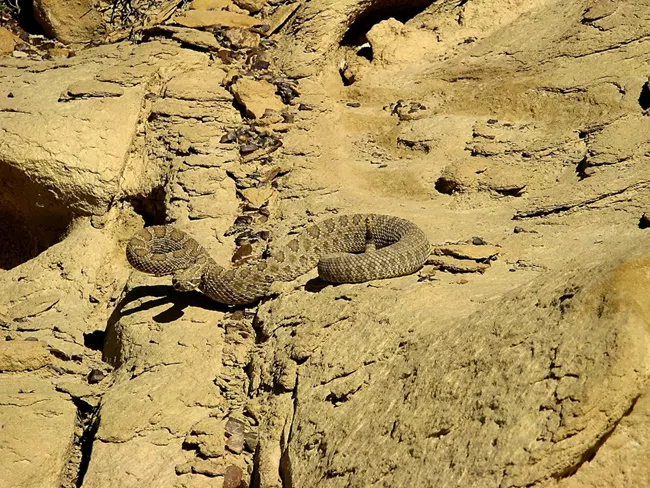


- Kingdom - Animalia
- Phylum - Chordata
- Class - Reptilia
- Order - Squamata
- Family - Viperidae
- Species - Crotalus viridis
- Wormy little guys, blending into dry grasses and tan stone.
“True” terrestrial animals no longer bound by water (Well they still are but not as bad) this is because of their scales and proper lungs. The scales help with retaining their moisture and the lungs keep them oxygenated without the need to breath through their skin.
Snakes are weird for reptiles having traded their limbs for ball-jointed ribs. This makes them similar to worms or slugs in movement ways but snakes get boogie with it, as only a few species move in an inchworm style.
They specifically are rattle snakes (pit viper sub-type) where they have to large pits near the nostrils that allow them to sense infrared. They also have specified tails where with each shed they gain a new segment in a rattle. Coloration in this species is dependent on subspecies, ranging from grey to red, tan to pink.
They eat a verity of rodents depending on where they live. They have also been known to birds, any type of egg, and other reptiles.
They reproduce much like birds but lay larger clutches of 4 to 21 eggs. it take 2 to 3 years to reach sexual maturity, and can live up to 16 to 24 years.
Found mostly in rocky or grassland areas, but can be found in forested areas depending.
Mostly eaten by large birds, few animals try to eat them due to their venom. Said venom can cause hemorrhaging and necrotic damage.
They are a G5 Secure on the NatureServe Explorer scale.
